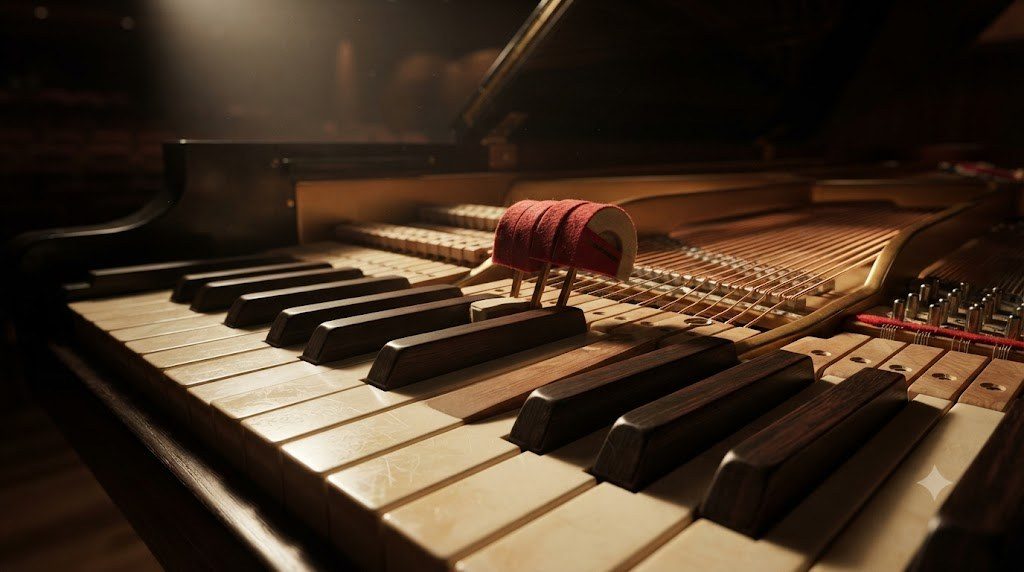
Orthographic Semiotics & Harmonic Voice-Leading Grammar
An authoritative music theory dissertation on the orthographic logic of pitch spelling. We examine Scientific Pitch Notation (SPN / American Standard Pitch Notation from C0 to B8), the syntactic function of accidentals (Sharps, Flats, Naturals, Double Sharps, Double Flats), and formulate why C# and D♭ are enharmonically equivalent on a keyboard yet fundamentally distinct in functional harmonic syntax.
Sit down at any standard modern acoustic piano and strike the black key nestled between the white keys C and D. What note are you playing? A casual beginner will answer: “That’s C-sharp… or D-flat, it’s the exact same note!”
In physical acoustics on a 12-Tone Equal Tempered keyboard, that black key does indeed trigger a single vibrating steel wire producing an identical frequency of 277.18 Hertz (C#4 / D♭4). Yet, if an orchestral composer writes a D-flat in a score where a C-sharp is required by the harmonic grammar, professional musicians will stumble, and the functional logic of the music collapses into orthographic nonsense!
Why does music theory strictly maintain distinct identities for Enharmonically Equivalent Notes? How do accidentals (sharps, flats, double-sharps, double-flats) function as directional vectors of musical tension and release? In this comprehensive study of pitch spelling and Scientific Pitch Notation (SPN), we reveal the profound architectural grammar governing musical orthography.
1. Scientific Pitch Notation (SPN): The Acoustical Octave Standard
Before analyzing enharmonics, we must establish a precise, unambiguous naming system for every note across human hearing. Historical European naming conventions (such as the German Helmholtz Pitch Notation with sub-contra, contra, great, small, one-line, and two-line octaves using apostrophes: C, c, c', c'') were cumbersome and error-prone in international academic literature.
In 1939, the Acoustical Society of America standardized Scientific Pitch Notation (SPN) (also known as American Standard Pitch Notation – ASPN). SPN combines the traditional letter name of the pitch class (A through G) with an Octave Number Integer (0 through 8+):
- The Octave Boundary Rule: An octave integer number changes EXCLUSIVELY upon passing the note C! The notes in Octave 4 ascend:
C4, D4, E4, F4, G4, A4, B4. The very next semitone above B4 is C5! The note B3 sits immediately below C4. - Middle C = C4: Middle C on the piano keyboard is universally labeled C4 (261.63 Hz).
- Concert Pitch = A4: Orchestral tuning pitch is A4 (440.0 Hz).
- Standard 88-Key Keyboard Span: Begins at A0 (27.5 Hz) and extends to C8 (4,186 Hz).
- Sub-Audio & Ultrasonic Extensions: Human hearing spans roughly
20 Hz (near E0)to20,000 Hz (near E10). Organ pedal pipes routinely reproduce C0 (16.35 Hz), creating tactile infrasonic floor vibrations felt in the chest cavity rather than heard by the ear!
2. The Taxonomy of Musical Accidentals: Altering the Diatonic Canvas
The seven natural letter names (A, B, C, D, E, F, G) define the ancient diatonic white-key collection of the piano. To access the remaining five chromatic pitches within the twelve-tone octave—and to modulate between keys—music notation uses Accidentals:
- Sharp (♯): Raises the pitch by one semitone (+100 cents). (Example:
C → C#). - Flat (♭): Lowers the pitch by one semitone (-100 cents). (Example:
D → D♭). - Natural (♮): Cancels any preceding sharp, flat, double-sharp, or double-flat, restoring the note to its natural white-key state.
- Double Sharp (𝄪): Raises the pitch by two semitones (one whole step, +200 cents)! Written as an ornate stylized ‘x’ with serifs. (Example:
F𝄪sounds identically toG). - Double Flat (𝄫): Lowers the pitch by two semitones (one whole step, -200 cents)! Written as two interlocking flat symbols (
♭♭). (Example:B𝄫sounds identically toA).
The Lifetime and Scope of an Accidental:
Under standard Western notation rules, an accidental written on a specific line or space remains in effect for all subsequent notes on that exact line or space for the remainder of that single measure (bar)! The moment the music crosses a vertical bar line into the next measure, the accidental’s power evaporates completely, and the note automatically reverts to the prevailing Key Signature unless explicitly re-stated or accompanied by a courtesy Cautionary Accidental in parentheses.
3. Why C-Sharp Is NOT D-Flat: The Law of Harmonic Function and Diatonic Spelling
Now we arrive at the core philosophical question: why can’t a composer simply write D♭ whenever it saves space, even if the key is A Major? Because Musical Spelling communicates DIRECTIONALITY, VOICE-LEADING, and FUNCTIONAL RELATIONSHIPS!
Consider the English language: the words “there”, “their”, and “they’re” sound 100% acoustically identical when spoken aloud (they are “phonetically enharmonic”). Yet if someone writes: “They left there coats over they’re”, any literate reader immediately experiences cognitive friction! The exact same grammatical rule governs musical notation:
- The Diatonic Scale Completeness Rule: Every standard seven-note diatonic scale (Major, Natural Minor, Harmonic Minor) MUST contain exactly ONE of every letter name (A through G) in strict consecutive alphabetical order!
- In the key of D Major (which has two sharps: F# and C#), the scale is spelled:
D – E – F# – G – A – B – C# – D. Notice that every letter name appears once! - If you improperly spell that 7th scale degree as
D♭instead ofC#, the scale becomes:D – E – F# – G – A – B – D♭ – D! Suddenly, the letter C has vanished entirely, while the letter D appears twice! A musician reading this on a staff would see two notes sitting on the exact same space/line, completely obscuring the melodic interval!
- In the key of D Major (which has two sharps: F# and C#), the scale is spelled:
- Voice-Leading Directionality (Tendency Tones): In functional harmony, Sharps resolve UPWARD, while Flats resolve DOWNWARD!
- C# as a Leading Tone: In the key of D Major,
C#is the 7th scale degree (the Leading Tone). It sits a narrow half-step below the tonic D and creates intense magnetic tension demanding an upward melodic resolution into D (C# → D). - D♭ as a Lowered Supertonic (Neapolitan): In the key of C Major,
D♭is a chromatic alteration of scale degree 2. It creates downward gravity, pulling the melody downward into C (D♭ → C)! Writing a C# when resolving downward to C violates the kinetic vector of Western music.
- C# as a Leading Tone: In the key of D Major,
4. Enharmonic Pitch & Scientific Frequency Reference Matrix
The exact 12-TET fundamental frequencies (A4 = 440 Hz), primary enharmonic spellings, Scientific Pitch Notation coordinates, and harmonic roles across the central octave (Octave 4) are detailed below:
| Primary Note Name | Enharmonic Spellings | 12-TET Frequency | Air Wavelength | Primary Harmonic Function & Voice-Leading Role |
|---|---|---|---|---|
| C4 (Middle C) | B#3 / D𝄫4 | 261.63 Hz | 1.311 m | Tonic root of C Major / Natural white key foundation |
| C#4 / D♭4 | B𝄪3 | 277.18 Hz | 1.237 m | Leading tone to D (C#) vs Neapolitan flat 2 in C (D♭) |
| D4 | C𝄪3 / E𝄫4 | 293.66 Hz | 1.168 m | Supertonic of C Major / Dominant of G Major |
| D#4 / E♭4 | F𝄫4 | 311.13 Hz | 1.102 m | Leading tone to E (D#) vs Minor 3rd of C minor (E♭) |
| E4 | D𝄪3 / F♭4 | 329.63 Hz | 1.041 m | Major 3rd of C Major / Diatonic leading tone in F# minor |
| F4 | E#4 / G𝄫4 | 349.23 Hz | 0.982 m | Subdominant of C Major / Leading tone to F# (E#) |
| F#4 / G♭4 | E𝄪3 | 369.99 Hz | 0.927 m | Raised 4th tritone (F#) vs Subdominant flat 5 in C (G♭) |
| G4 | F𝄪4 / A𝄫4 | 392.00 Hz | 0.875 m | Dominant root of C Major / Anchor line of Treble Clef |
| G#4 / A♭4 | None common | 415.30 Hz | 0.826 m | Leading tone to A (G#) vs Minor 6th of C minor (A♭) |
| A4 (Concert Pitch) | G𝄪4 / B𝄫4 | 440.00 Hz | 0.780 m | Global orchestral tuning standard / Submediant of C |
| A#4 / B♭4 | C𝄫5 | 466.16 Hz | 0.736 m | Leading tone to B (A#) vs Dominant 7th of C (B♭) |
| B4 | A𝄪4 / C♭5 | 493.88 Hz | 0.695 m | Diatonic leading tone of C Major / Flat 7th in D♭ Major (C♭) |
| C5 (Octave C) | B#4 / D𝄫5 | 523.25 Hz | 0.656 m | Octave ceiling of central tessitura |
5. The Diatonic Circle of Fifths and Key Signature Accidentals
Why do key signatures accumulate sharps and flats in a rigid, unchanging order? If you inspect any piece of published sheet music from J.S. Bach to contemporary cinema scores, sharps and flats never appear randomly on the staff! They follow the exact geometric progression of the Circle of Fifths:
- The Order of Sharps (Ascending Fifths from F):
F# → C# → G# → D# → A# → E# → B#(Memorized via: “Father Charles Goes Down And Ends Battle”).- Notice that each sharp is a Perfect Fifth higher than the previous one! Every time a key signature adds a sharp, that new sharp is always the Leading Tone (7th scale degree) of the new Major key (e.g., adding C# creates D Major; adding G# creates A Major).
- The Instant Sharp Key Recognition Trick: To immediately identify any Major key with sharps, look at the last sharp on the far right and ascend by a single half-step! (If the last sharp is D#, the key is E Major; if the last sharp is A#, the key is B Major).
- The Order of Flats (Descending Fifths / Ascending Fourths from B):
B♭ → E♭ → A♭ → D♭ → G♭ → C♭ → F♭(The exact reverse of sharps: “Battle Ends And Down Goes Charles’ Father”).- Every time a key adds a flat, that new flat is the Subdominant (4th scale degree) of the new Major key.
- The Instant Flat Key Recognition Trick: To identify any Major key with two or more flats, look at the second-to-last flat from the right—that flat IS the name of the Major key! (If the key has B♭, E♭, A♭, the second-to-last flat is E♭, so the key is E♭ Major!).
6. Theoretical Keys and Double Accidentals: Why F-Double-Sharp Exists
Beginner students frequently complain: “Why do double sharps and double flats exist? Why would anyone write F-double-sharp (𝄪) when they could just write G?”
Let us look at a real-world harmonic necessity that arises in the classical repertoire: The Harmonic Minor Scale and the Leading Tone Rule:
- The Key of G# Minor:
- The Natural Minor scale of G# is built from the key signature of B Major (5 sharps: F#, C#, G#, D#, A#):
G# – A# – B – C# – D# – E – F# – G#. - To form the Harmonic Minor Scale (essential for creating a dominant V chord and strong cadence resolution), Western music theory strictly requires raising the 7th scale degree by one semitone to create a half-step Leading Tone to the tonic G#!
- The 7th note in G# minor is already an F#. To raise an already-sharped note by another half-step, you MUST apply a Double Sharp:
F𝄪! The scale is correctly spelled:G# – A# – B – C# – D# – E – F𝄪 – G#. - If you lazily spell that 7th note as
G-natural, the scale becomes:G# – A# – B – C# – D# – E – G♮ – G#! You have completely erased the letter F from the scale, created an impossible chromatic semitone leap between E and G♮, and written two conflicting G notes in the same measure—destroying harmonic clarity for the performer!
- The Natural Minor scale of G# is built from the key signature of B Major (5 sharps: F#, C#, G#, D#, A#):
- Theoretical Keys with 8 or More Accidentals: If a piece written in D# Major were published, its key signature would require eight sharps (including F𝄪 in the key signature!). Because reading eight sharps is mentally exhausting, composers use an Enharmonic Key Signature Change—switching from D# Major (8 sharps) to its acoustically identical twin E♭ Major (only 3 flats!)!
7. Enharmonic Modulation: Beethoven and Schubert’s Harmonic Teleportation
Beyond clean notation spelling, enharmonic equivalence is one of the most powerful compositional tools ever wielded by master composers like Ludwig van Beethoven, Franz Schubert, and Frédéric Chopin. It is called Enharmonic Modulation—a musical magic trick where a chord is spelled in one key, and then re-spelled enharmonically in midair to suddenly transport the listener to an alien, distant tonal galaxy in a single bar!
- The Symmetrical Diminished Seventh Chord (The Universal Modulator): A fully diminished 7th chord is built entirely of stacked minor thirds (each 300 cents wide), dividing the 1,200-cent octave into four perfectly equal quadrants.
- Consider the chord:
C – E♭ – G♭ – B𝄫(the vii°7 resolving to D♭ Major). - Re-spell the
B𝄫enharmonically as an A-natural:C – D# – F# – A(now it is the vii°7 resolving to E Major or B Major!). - Because all four inversions sound identical on an equal-tempered keyboard, a composer can play a single chord in the home key of C minor, re-spell a single note enharmonically, and resolve with effortless elegance into the distant key of F# Major—jumping across the entire diameter of the Circle of Fifths in a single heartbeat!
- Consider the chord:
- The German Augmented Sixth to Dominant Seventh Pivot: Similarly, a German Augmented Sixth chord in C minor (A♭ – C – E♭ – F#) sounds acoustically identical to a Dominant 7th chord on A♭ (A♭ – C – E♭ – G♭). Re-spelling F# as G♭ allows effortless modulation from classical minor keys into sparkling remote major keys!
Orthographic Golden Rules for Composers and Arrangers
1. Sharps Go Up, Flats Go Down: When writing chromatic passing tones, raise the previous note with a sharp if ascending (C → C# → D), and lower the next note with a flat if descending (D → D♭ → C).
2. One Letter Per Diatonic Degree: Never allow two adjacent notes in a diatonic scale or triad to share the same letter name.
3. Embrace Double Accidentals: Do not fear 𝄪 and 𝄫—they preserve the underlying structural logic of Western voice leading!


